Saturday, December 05, 2009

Google chooses Collins COBUILD dictionary

Google launched its new dictionary service this week. Poking around, I randomly came up with the word attribute and tried it out. The defining style was immediately familiar, so I jumped over to the Collins website, and searched for attribute there. The two entries are not identical, but they're close enough as to show this is almost certainly Google's source. Here's Google's entry:

  • If you attribute something to an event or situation, you think that it was caused by that event or situation. VERB
    • Women tend to attribute their success to external causes such as luck. V n + 'to'


  • If you attribute a particular quality or feature to someone or something, you think that they have got it. VERB
    • People were beginning to attribute superhuman qualities to him. V n + 'to'
    • attribution N-UNCOUNT oft N 'of' n   /'ætrɪbj'uːʃən/
      • There's usually a lot of attribution of evil intent to those who have different views.


  • If a piece of writing, a work of art, or a remark is attributed to someone, people say that they wrote it, created it, or said it. VERB usu passive
    • This, and the remaining frescoes, are not attributed to Giotto. 'be' V-ed + 'to'
    • ...a Madonna and Child attributed to Pietro Lorenzetti. V-ed


  • An attribute is a quality or feature that someone or something has. N-COUNT usu with supp
    • Cruelty is a normal attribute of human behaviour.
    • He has every attribute you could want and could play for any team.


  • Followed by the Collins COBUILD entry:
    (FORMAL)If you attribute something to a personthingor eventyou believethat they cause it or have it. Women tend to attribute their successto luck... People were beginning to attribute superhuman qualitiesto him.verbIf a piece of writing or a remark is attributed to someonepeoplesay that that person created it or said it. ...a play attributed toWilliam Shakespeare.n-count[ˈætrɪbjuːt]An attribute is a quality or feature. Cruelty is a normal attribute ofhuman behaviour.
    What do you think? Notice that while the wording differs here and there, and Google has more senses listed, it's strikingly similar. Even some of the examples are the same.

    I think it's a great choice. The COBUILD was revolutionary when it came out, and it's still a damn fine dictionary.

    Friday, December 04, 2009

    Firsten turns over a new leaf

    Despite the demise of TESOL's Essential Teacher magazine, where Richard Firsten used to ply his trade, TESOL has found his goofy grammar guidance so indispensable that they continue to promulgate it through the web-based TESOL Connections. This time around, though, he gets it mostly right.

    I wouldn't call We’d rather he didn’t, "the present subjunctive" as he does, and as I've said before, I think he's wrong that the we in we teachers is a pronoun. But these are mostly terminological matters. Generally, the answers make sense. If he plans to keep up this schtick, then let's hope he continues in this vein.

    Monday, November 30, 2009

    Girl, 13, gets perfect TOEFL score

    The Korea Herald reports that Kim Hyun-soo got a perfect score on the iBT TOEFL. This speaks to much more than Kim's English ability as most 13-year-old native speakers of English would not be able to deal with the cognitive academic aspects of the test.

    Sunday, November 29, 2009

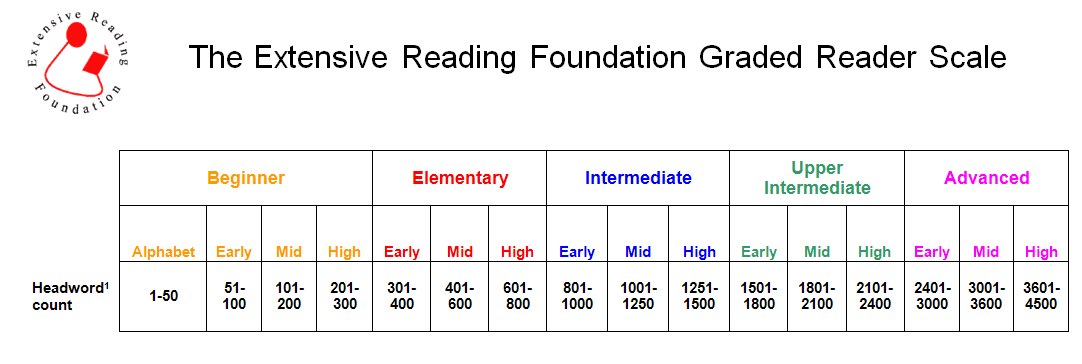
    New Scale for Graded Readers

    The indefatigable Rob Waring has been hard at work with the Extensive Reading Foundation to set up a publisher-independent scale which has recently been published on the foundation's website.


    There is a detailed table that shows how each publisher's own levels relate to this scale with helpful links to every series of graded readers known to mankind.

    In the Humber library, we have always used David Hill's EPER scale, and will continue to do so, but if I were setting up a new program, I'd probably switch to the new scale for its increased breath and detail and since you have to pay for EPER stuff.

    Wednesday, November 25, 2009

    A mere puff

    Do people hear with their skin as well as with their ears? Henry Fountain has an article in the New York Times describing some research suggesting that indeed we do.
    The researchers had subjects listen to spoken syllables while hooked up to a device that would simultaneously blow a tiny puff of air onto the skin of their hand or neck. The syllables included “ba” and “pa,” which produce a brief puff from the mouth when spoken, and “da” and “ta,” which don’t produce puffs. They found that when listeners heard “da” or “ta” while a puff of air was blown onto their skin, they perceived the sound as “ba” or “pa.”
    The problem with this is that syllable initial voiceless consonants, including /p/ and /t/ are aspirated; that is, they produce a brief puff of air, whereas voiced consonants, including /b/ and /d/ are unaspirated. The error appears to be Fountain's; the abstract in the original paper gets it right.

    [The article has since been corrected.]

    Monday, November 23, 2009

    More on imperatives

    Over the weekend, I commented that most of the ten commandments were not in the imperative mood. In particular, I said thou shalt not is in the indicative mood. I've had a number of people query this, so I'd like to explain more.

    Saturday, November 21, 2009

    Ben Yagoda on Language

    Having just written a post questioning the value of taking on a century-old usage book, I turn to a number of columns written by author, critic, and teacher Ben Yagoda, one of which is more than twenty years old.


    Thursday, November 19, 2009

    Jan Freeman's new book


    I may be betraying my lack of education, but I'd never heard of Ambrose Bierce before Jan Freeman offered to send me her book, Ambrose Bierce's Write it Right: The Celebrated Cynic's Language Peeves Deciphered, Appraised, and Annotated for 21st-Century Readers. Or at least I thought I hadn't heard of him. Doing some background reading, I found that I'd actually read some of his short stories in high school or perhaps university. It made me feel somewhat better that only one person in the office here had heard of him at all.

    Saturday, November 14, 2009

    Conrad Black, English teacher

    Conrad Black seems to have discovered the joys of being an English teacher. I'm a little curious, though about his "commending Hemingway's Snows of Kilimanjaro as illustrative of the virtues of short, simple sentences." I assume he doesn't have sentences like the following in mind:

    Friday, November 13, 2009

    Award-winning students

    Most of the students who pass though our English for Academic Purposes (EAP) program end up doing very well in the college. This was highlighted in October when the awards and scholarships were handed out for the school of liberal arts and sciences. Here at Humber, LAS services students in every program and includes some of the most language-dependent courses. Despite this, former EAP students took home many awards:

    Thursday, November 12, 2009

    Subtitles for ELLs

    Holger Mitterer and James M. McQueen have published a paper in PLoS ONE suggesting that if you're a learner of English, you should watch TV with English subtitles turned on. I regularly assign graded readers to students, and I suggest to those who read poorly (i.e., are slow and/or inaccurate at decoding individual words), and those with difficult-to-understand accents that they chose a reader that comes with a CD. I think this is basically the same process. In these learners, there's either no link between phonology and meaning & orthography (spelling), or the phonological representation is faulty. This paper shows that there are benefits to linking them together.

    Monday, November 09, 2009

    100 things restaurant staffers should never do

    One of the most e-mailed stories at the NY Times this week is "100 things restaurant staffers should never do" by Bruce Buschel. This may seem a little glib, but as I was reading it, I was thinking: what a great exercise for language teachers! How many of these can you apply to your teaching situation?

    Saturday, November 07, 2009

    There aren't much data

    When asked by the New York Times why some people get a sore arm at the site of a flu vaccine injection while others do not, Dr. E. Yoko Furuya, assistant director of epidemiology at NewYork-Presbyterian Hospital/Columbia University Medical Center replied, “The short answer is that we don’t know for sure... There aren’t much data out there on this topic.”

    Wednesday, November 04, 2009

    Subordinate clauses

    The Cambridge Grammar of the English Language sets out the language in piercing detail, but I often find it overwhelming and need to step back and bring together what I've read in a way that displays the basic relationships minus overmany particulars. Recently, my attention has been on subordinate clauses. Five years ago I would have said I had a good understanding of subordinate clauses, but how wrong I was. The more I delved into it, the more I found and the more lost I felt.

    In the following taxonomy/tree diagram/organizational chart, or what-have-you, I've attempted to illustrate the relationships between all these various subordinate clauses. As time allows I'll add example sentences to illustrate each.


    PS, If somebody can conjure an elegant way to allow telescoping of the various daughter levels (click-to-expand kind of thing) along with links to example sentences, please let me know.

    Thursday, October 29, 2009

    Aspectual properties of the VP

    Last night I realized that in my previous post about aspectual properties of verbs, I wrote about "stative verbs" and "dynamic verbs". I suppose it is useful to identify verbs that allow stative and/or dynamic interpretations, but I should also have pointed out that in the final analysis, it is not the verb per se that is stative or dynamic. Rather, it is a property of an entire VP. For example, I'm going to have a shower has the dynamic VP have a shower where I have a shower in my basement has the stative VP have a shower in my basement.

    Wednesday, October 28, 2009

    Negating should in questions

    Part III of our dissection of the most recent Grammatically Speaking column brings us to the question: "what's wrong with should not they have permission."

    Richard Firsten opines, "actually, there is nothing ungrammatical with the question Should not they have permission . . . ?, but it's certainly very uncommon and probably never heard or even written anymore. A very long time ago this construction was sometimes used."

    Tuesday, October 27, 2009

    Until he fixes/fixed it

    This post is a continuation of this one. In his usual form, Richard Firsten explains,
    . . . until he fixes it shows that the speaker is dealing with a real situation. We know this because the speaker is using the verb fix in the simple present in the indicative mood. There really is something broken, and from what we can gather, the repairman has asked for payment in advance. What we have here is the advice that the speaker is giving to the person who needs the repair work done.
    . . . until he fixed it shows that the speaker is talking about an unreal situation, a hypothetical case. We know this because the speaker is using fix in the simple present subjunctive mood. Nothing is broken at this time, but the two people are discussing "what-if's," that is, what one or the other would do if such a situation were to develop.

    Monday, October 26, 2009

    Voice not confused with tense by an economist

    Worthwhile Canadian Initiative is an economics blog I read regularly. In his most recent post, Stephen Gordon, an economist accurately diagnoses the shifty use of the passive voice (about two screens down) by a Globe and Mail editorial. It's a small thing, but still encouraging that a non-linguist gets this right at a time when educated people from writers and editors at The Economist to the director of student counselling services at University College Dublin clearly have no idea what the passive voice is.

    Friday, October 23, 2009

    CLB Online Self Evaluation

    A colleague pointed me to the Canadian Language Benchmark's Online self-evaulation site. If you're on a mac, you won't even get past the splash screen, which appears broken, but on windows with Explorer, you should be OK.

    I found no stats about reliability, etc. But it appeared to be a reasonably well-designed test of reading and listening skills. I only tried the English version, but I assume there's also a French version. Off the top of my head, I would say the questions range from CEFRL level A1 to B1, or perhaps B2 with most being in the lower part of that range. There is nothing particularly difficult.

    It appears that the site is still in Beta. Some problems I noticed:

    Thursday, October 22, 2009

    Grammatically speaking is wrong again (and again, and again)

    The newest "Grammatically Speaking" column from TESOL's Essential Teacher magazine is out and, as usual, it's hit and miss with its answers. For past discussions of Richard Firsten's misanalyses, see these posts. As I've said before, I keep coming back to these because it seems to me that it behooves a grammar pundit like Firsten to make sure he's got the right answers. You don't expect perfection, but I think he's only batting slightly above 500. The other reason is that he gets a lot of interesting questions.

    Wednesday, October 21, 2009

    What do people want to know about language?

    The search terms that lead people here are often interesting. Here are some recent gems:
    • plural of t (same as any other letter, I'd think) 
    • how many adverbs are in the sentence: zack jumped incredibly high (this guy thinks Google actually understands his question) 
    • granted as a preposition (it is often) 
    • hair countable (it isn't typically) 
    • is 0 plural or singular (plural when it's like 'zero things are...', but singular in 'one zero is') 
    • what are determinative adjectives in english (I don't know) 
    • three linking verbs (reminds me of a Christmas carol) 
    • free online tests for 10 - 11 year olds (in case you're not sure how old the kids are) 
    • most overused words 2007 (it's still the
    • Is the word rather a preposition (I don't think so; I'd say adverb and coordinator)

    Ethical review

    We occasionally get students coming to us with wildly unrealistic expectations about where they will be placed in our program. Some of them think they'll be in the English for Academic Purposes program for two months when in fact they're placed in level 2, which means at least 14 months. Of course, they've already put their lives on hold, invested a bunch of money, and flown over here.

    Sunday, October 11, 2009

    When the parrot sketch disappears ...

    I do understand the importance of data-oriented studies. In fact, I was one of the contributors to the first corpus-based English-Japanese dictionary (the Wisdom EJ from Sanseido).

    When I wrote the entry for 'prejudice', for instance, I included the phrase 'pride and prejudice' because there was a significant number of occurrences of the phrase in the corpus we used, and frankly, this famous title should be known to anyone studying English, whether they have read the novel by Jane Austin or not. Yeah, the story's crap, I know, but it is very well known.

    Wednesday, October 07, 2009

    More computer-graded English

    Today's Toronto Star has an article about a site called Speak2me.cn that uses voice recognition software to help students practice their speaking skills. It's the first free online site I've seen doing this, but it surely won't be the last. In an interesting move, they use product placement in their dialogues as a source of income.

    I wanted to try it out, but you really need to be able to read Chinese to use it. If anybody has more success than me, please, let me know what you think.

    Tuesday, October 06, 2009

    Book Launch tonight

    If you're free in Toronto tonight between 5:00 and 6:00, come to the launch of Slant Room by Michael Eden Reynolds.

    Duo-tang

    All my life, I've been vaguely aware that there's something about the word duo-tang that I was missing. It seemed like such an odd English word. Then, the other day, my daughter brought one home and the meaning hit me: duo = 2, tang = tongue-like projection (you can see three of them in the photo below).


    It seems like I'm not the only one to miss the meaning. Here's a "duo-tang" with not a tang in sight. I suppose, though, that you can forgive the company its expanding use of a brand name.

    Sunday, October 04, 2009

    Had yet to consider this point

    As I wrote my last post, I paused upon writing have yet to. "What's that?" I thought.

    I feels like the present perfect, but instead of the past participle, it has a to-infinitival. Indeed, it seems equivalent in meaning to have not yet + past participle. But if you take out yet, you get have to, suggesting obligation. Are these related?

    Saturday, October 03, 2009

    Scenic Learning

    A recent NewScientist article mentions some research led by Katrin Hille at the Transfer Centre for Neurobiology and Learning.

    "Her team recently tested a novel approach to foreign language classes that originated in a school. Teachers at Gymnasium Kirchheim in Kirchheim by Munich, Germany, had found apparent success with a technique called 'scenic learning', which involves choral recitals of vocabulary accompanied by gestures and movements matched to meaning.
    In a study of 137 students, Hille found those who had used scenic learning remembered three times as many new words 14 weeks later as those who had been taught using conventional methods, and spoke with better pronunciation and fluency. 'I have never seen such strong effects in a previous study,' says Hille."

    The last sentence is pretty startling, but that's the whole thing, and I've been unable to find any mention of it anywhere else. Perhaps it was simply a conference paper that has yet to be published. Anyhow, I've sent off an e-mail, and if I learn anything more, I'll follow up here.

    Tuesday, September 29, 2009

    Pearson test of English Academic to go live

    The first new major (or so they hope) test of academic English will be rolled out next month when Pearson introduces the Pearson Test of English Academic (the acronym sounds like you're spitting out something unpleasant). Following on the success of their Versant tests of spoken English, which are entirely computer graded (with the option of in-house human grading), the PTE A will employ computer grading exclusively for all test sections, including the speaking and writing sections. I believe this is the first major test of English to do so.

    Sunday, September 27, 2009

    If I were popular

    A few nights ago, my mother commented how surprised she had been to hear my five-year old daughter say if I were. I'm not sure I've heard it, but I'm not surprised that she would have said it. To my mother it seemed both complex and dated. My manager has also said that teaching TESL over the years there have been fewer and fewer students who say they use this form, and even some who claim never to have heard it.

    Friday, September 25, 2009

    When singular and plural aren't

    My aunt pointed out to me a recent Scientific American article by Marc Hauser (the article link, unfortunately, only takes you to a teaser). Therein he points out that even though we think of the plural form of nouns being used for more than one, this isn't always the case.

    We English speakers are somewhat inconsistent in what we decide to mark as plural. Allow me to illustrate: You is plural even when it refers to only one person. One megabit is singular even though it's 1,000,000 bits (or sometimes 1,048,576 bits). One apple is singular, but 1.0 apples is plural. Half an apple is singular, but 0.5 apples is plural. More than one apple is singular. And perhaps most confounding of all, zero apples is plural.

    Hauser says this last is "actually ungrammatical" (I think that was the exact wording, though I don't have it in front of me.) Nonsense! It's perfectly grammatical. Just because the grammarians who chose the term plural for this part of our number system suffered from a lack of analysis/imagination, doesn't make the system wrong. Labels are not definitions, and they certainly are not invocations.

    Tuesday, September 22, 2009

    Book Launch

    My brother (Michael Eden Reynolds)'s book Slant Room is being launched at Toronto's Ben McNally book store at 366 Bay St. on Tuesday, Oct 6 from 5:00-7:00. Drop by and say hello.

    Friday, September 18, 2009

    The state of linking verbs

    I've recently realized that there is some confusion surrounding two classifications of English verbs: linking verbs vs. non-linking and stative verbs vs. dynamic verbs [see update here]. Last year, I observed a practicing teacher who didn't understand the difference. She had confounded linking verbs and stative verbs leading her to explain to the student that active verbs are modified by adverbs while linking verbs are modified by adjectives. As they went through the exercises, the students were quick to notice where the facts didn't fit her "rule" and it went downhill from there. She tried to dig herself out by appealing to what sounds right and "exceptions". I was just there as a guest, so I smiled and bit my tongue.

    Tuesday, September 15, 2009

    Verb vs preposition

    "Next week, we're versing the black team." Or so says my son.

    I've pointed out to him that most English speakers don't have verse as a verb, but that doesn't seem to deter him. And why should it? His friends all use it that way, and I know exactly what he means; there's no miscommunication.

    Friday, September 11, 2009

    Free, online tests of English

    We occasionally have students show up from abroad expecting to enter a post-secondary program in a month or two only to find out that they are going to have to spend a year in the pre-college English for Academic Purposes (EAP) program. Needless to say, time and money budgets have not been prepared with EAP in mind. Visa's may have to be reworked, waiting jobs and study may have to be put off or lost, and there is a good deal of frustration all around.

    All this could be avoided if only applicants were better able gauge their own English proficiency and interpret that against the requirements of the school. As a first step towards realizing this, I've gathered together a number of free online and downloadable tests that vary in their length, accuracy, and feedback. Individually, each can give international students some hint about their level, and, when taken together, are likely to give candidates quite a good picture of their proficiency.

    The next step is now to begin to calibrate the tests against our own entrance requirements. It should prove to be an interesting project.

    And of course, there is no intention whatsoever to use these for high stakes purposes. They are intended only as a tool to help international students plan their time here before they come over and are seriously disappointed.

    I'd like to thank Russell Kent, Jim Purpura, Glen Fulcher, and the other folks from the L-Test mailing list who offered ideas.

    Wednesday, September 09, 2009

    When more cash is less cash

    "Ottawa, provinces sign bilingual education deal" trumpets the Winnipeg Free Press. OK, maybe trumpets is a bit hyperbolic. What do you think about piccolo as a verb?

    Anyhow, "The federal and provincial governments signed a new four-year minority-language education agreement worth more than $1 billion." This is a 1.5% increase over the previous deal. In other words, it's less than half a percent a year, well below the cost of inflation. I suppose they could have cut funds outright...

    Tuesday, September 08, 2009

    Teaching without declarative understanding

    There are lots of things you do without understanding how you do them. Mostly this is not a problem. But if you are hired to teach others to do whatever it is, you run into a problem. When it comes to teaching writing, it can be a major problem. Art Scheck eloquently expresses the hollow feeling that can result in an article in The Chronicle of Higher Education.

    It's something I've certainly dealt with. Personally, my approach has been to look to psychology, psycholinguistics and cognitive science for answers. Perhaps hints or notions is more like it, but it's better than having no clue at all.

    Friday, September 04, 2009

    Language Learner Literature Awards 2009

    The 6th annual Language Learner Literature Awards have been announced. Congratulations to the winning authors, editors, and publishers! Congratulations also the Extensive Reading Foundation for running such a worthwhile event.

    Young Learners:
    Farley the Red Panda
    Series editor: Rob Waring
    Contributing writer: Sue Leather
    Footprint Reading Library; Heinle
    ISBN: 9781424011582
    Aimed at older children at lower-intermediate level, the text combines narrative and factual information to win sympathy for the fighting spirit of a young animal and admiration for the helping humans.

    Adolescent & Adult: Beginner:
    Why? by Philip Prowse
    Cambridge English Readers
    ISBN: 9780521732956
    Pioneering. Serious issues are presented in excellent, understandable prose complemented by superb illustrations. It is a good story which has a human dilemma at the heart of it.

    Adolescent & Adult: Elementary:
    White Fang by Jack London; Retold by Rachel Bladon
    Macmillan Readers
    ISBN: 978-0-2300-2673-5
    A gripping story that is just as gripping in its adaptation. The technical skill of structural and lexical control is first class, and the illustrations support comprehension.

    Adolescent & Adult: Intermediate:
    Land of My Childhood: Stories from South Asia Retold by Clare West
    Oxford Bookworms Library World Stories
    ISBN: 9780194792356
    These touching, engaging stories open up other worlds while making you think more about your own. Clare West is a master storyteller. Each story she retells is complete without spelling out every detail. As one reader put it, she “gives readers enough imaginary space”. An excellent collection.

    Adolescent & Adult: Upper Intermediate & Advanced:
    Nelson's Dream by J. M. Newsome
    Cambridge English Readers
    ISBN: 9780521716048
    It is a heart-warming love story set against the heart-wrenching background of the impact of HIV/AIDS. By placing the problem of HIV/AIDS in such a human context, the book encourages its readers to think about and discuss what is arguably this century's greatest challenge.

    Tuesday, September 01, 2009

    Stanford Study of Writing

    I don't currently teach a writing course, but I did teach a freshman composition course for two semesters and we do teach writing in our EAP program. I'm always looking for solid research about writing and the Stanford Study of Writing appears to be just that.

    Paul Rogers' dissertation seeks to identify key variables related to Stanford students' writing development across their four years of college and into their first year post-graduation. Especially interested in testing the hypothesis that two particular variables, audience awareness and rhetorical understanding of sources, are significant in students' writing development, Paul developed an original, 10 point rubric to score a sample of academic writing from 40 study participants. Twenty writing instructors participated in the scoring of a sample of academic writing from 40 study participants, achieving 86.6% inter-rater reliability. Paul also coded the nearly 150 interviews conducted during the five years of the study to gather further understanding of participants' beliefs about what most contributed to their writing development. Preliminary findings indicate:

    • Participants who scored high in rhetorical awareness of audience in their freshman year showed their greatest amount of growth in subsequent years, indicating this variable as statistically significant (p>.0001).
    • Writing development is non-linear; students develop at different paces, sometimes regressing across years, particularly as they are learning the nuances of genre-specific writing within disciplines.
    • Participants reported that conversations about writing with teachers, professors, teaching assistants, and post-doctoral fellows had the greatest impact on their writing development.
    • While positive feedback appears to increase student-writers' confidence, descriptive constructive criticism may be most salient to helping students move their writing forward.
    • Students valued feedback at all stages of the writing process, but especially early on in the process when feedback clarified teacher expectations, and clearly connected to writing and revision processes.

    Friday, August 28, 2009

    Review: The Psychology of Second Language Acquisition

    The Psychology of Second Language Acquisition by Zoltán Dörnyei was published on Feb 19, 2009 to very little fanfare. I found out about it through an Amazon.com alert, but even though I pre-ordered it, three months later Amazon shrugged and said, "Although we'd expected to be able to send this item to you, we've since found it's not available from any of our sources at this time."

    It now seems to be available, but it's not selling well at all. Today, the Amazon rank (for what that's worth; I expect these numbers jump around quite a bit) is #569,249. In comparison, Lightbown & Spada's How Languages are Learned is #1,011, Michael O'Malley's Authentic Assessment for English Language Learners: Practical Approaches for Teachers is # 7,341, and Rod Ellis's The Study of Second Language Acquisition is #44,171. Even Dornyei's other books are also selling much better (e.g. #79,777 for Research Methods in Applied Linguistics).

    What about reviews? Google books says, "We haven't found any reviews in the usual places," and I didn't have any better luck. I even had trouble tracking down the table of contents (here; scroll down past the Japanese). Not sure why this text is flying so far under the radar.

    Anyhow, I finally asked OUP to send me a copy, and they very kindly did on the promise that I'd write a review and post it here. So:

    Firstly, the target audience was not easy for me to identify. On one hand, it seems to be aimed at people who know almost nothing about language teaching. For example, it takes half a page to explain what the grammar translation method is, adding nothing that wouldn't be familiar to anybody who'd taken a TESL certificate course. But on the other hand, many of the topics brought up would have little relevance to anyone without some background in applied linguistics and language teaching, especially if you want to make sense of it as a whole. The series is supposed to be "aimed at applied linguists, lecturers, teacher trainers, students on advanced/postgraduate courses, and practitioners interested in gaining a wider perspective on their work," but I think it might have benefited by trying to be a bit more narrow in its range. As a text in an intro-to-psycholinguistics course, though, where it is supported by lectures, discussions, and other readings, it might work well.

    The first half of the book is mainly of interest to grad-students and researchers who are unfamiliar with cognitive psychology and may be interested in seeing how they personally might fit themselves and their research programs into this tile in the mosaic of academia. Dörnyei introduces and explains a multitude of approaches and terms including a brief lesson in the anatomy of the brain. There's very little here for most teachers.

    The second half, however, includes more that might help teachers think about their teaching differently, but it will take a careful reader who is good at seeing analogies to extract such insights. To be fair, there are no pat solutions for teaching language, but even the final chapter on the psychology of instructed second language acquisition seems to offer very little in terms of guidance for language teachers, though Dörnyei does inlcude six keys on the final page: Language instruction should...
    1. be meaning-focused and engaging while including practice activities to increase automaticity.
    2. include explicit instruction.
    3. pay attention to formal/structural aspects as well as meaning.
    4. teach formulaic sequences.
    5. include extensive exposure to massive amounts of the target language.
    6. and offer many opportunities to interact in the L2.
    The major thesis (there isn't really a main one) seems to be that researchers need to take a dynamic systems approach to studying second language acquisition. But since all that math is "impenetrable" to us language folk, rather than actually taking a dynamic systems approach, Dörnyei suggests that we try to take on some of its vocabulary and conceptual framework. And he tries to do so himself.

    He applies the metaphor of an attractor to a number of individual factors involved in SLA, one being future self-guides (generally, the idea that a clear vision of an ideal self is a motivating force). "future self-guides can be seen as broad attractor basins subsuming a variety of components." Although I understand very little about attractors, it seems to me that Dörnyei is at least two layers deep in metaphor and may have lost sight of what an attractor actually is. On the other hand, as I said, I don't understand attractors well, so this may in fact be a very apt description.

    In the end, Dörnyei does a good job of bringing much information together, but I wanted a lot more detail, not just the brief overviews offered. I did find quite a few references that I want to follow up. Three researchers really stand out as contributing disproportionately to the bibliography: Nick Ellis, Norman Segalowitz, and Jan Hulstijn along with Peter Robinson. I wonder if I'll find more of what I want in Robinson & Ellis's Handbook of Cognitive Linguistics and Second Language Acquisition. Maybe that will be my next review.

    Thursday, August 27, 2009

    Peel board of ed gets it right

    It looks like some folks at the Peel district school board (my local board) have been giving some serious thought to all the new immigrants in Brampton (more than half the school population doesn't speak English at home).
    "the board has centralized the registration of immigrant students at the three new centres in Brampton, Mississauga and Malton, where newcomers are assessed and offered orientation interviews before being enrolled in one of the board's 236 schools. The centres are made possible by a $3.7 million grant from Citizenship and Immigration Canada."

    Friday, August 21, 2009

    The Japan Times follows the TOEIC money trail

    James McCrostie has recently had two stories about the TOEIC tests published in the Japan Times. He appears to have done a lot of homework in tracking down the various players in the raveled money trail that the test takers feed.

    Saturday, August 15, 2009

    Verbs, prepositions, and in between

    Brett has raised an interesting question indeed. So, is compared a preposition? Or is it still a verb, which happens to share similar functions with prepositions?

    I like the arguments presented by Brett; but I am not sure whether I am totally happy to say that compared is now a verb in one construction, now a preposition in another. Some lexical items are like that, I know, but this one?

    I was thinking about this while taking a morning shower. My thoughts went like this -

    The problem is that compare is a verb, pure and simple. Compared to ..., accordingly, is felt to be a participial construction. It is not like during as in during the summer; today, it is hard to imagine using dure as a verb.

    Is it, then, perhaps more like the adjective interesting as in a very interesting book, which is no longer a participial form of the verb interest? Can you similarly say that compared as in Compared to ... is a preposition, no longer a participial form of the verb compare?

    The problem here is that the criterion we rely on is the somewhat shaky notion of the 'understood' subject. It may be the subject of the main clause; it may be 'recoverable' from the linguistic context; or, more subtly, it may be 'interpretable' pragmatically. Right now, I am not sure whether the 'understood' subject is a grammatical property.

    It is well known that coordination facts don't work well as syntactic arguments. Coordinated elements do not necessarily share a common grammatical category; they share a common function (today and on Wednesday).

    So, can we perhaps say that compared shares a similar function with prepositions, say, that of clausal modifier? If we can, then we can say that a phrase headed by the past participial form of compare can modify a clause it is attached to, in the same way a phrase headed by a preposition can.

    Then, if and when compared sufficiently loses its verbal properties, we will happily say 'Hi everyone, there was once a time when this was used as a verb, but now it is a preposition.' - and everyone will agree. Peace and happiness.

    My shower was not long enough to pursue this further, and now I have to run; I have a second-hand book festival to go to. The beauty of a blog-post is I can leave it here, and invite comments from everyone - whom I wish a very happy Sunday.

    Friday, August 14, 2009

    Even more departicipial prepositions

    This thread has been picked up on Language Log where thousands more eyes will see it than are likely here, leading to many interesting comments. These have pushed me to look for other "departicipial prepositions". Here are the candidate's I've found so far.
    1. It is the result of a colonial heritage that has permanently saddled a fundamentally Mestizo-Indian society with standards of appearance, beauty, and behavior that are not its own. Counteracting this frame of mind today, there is a significant intellectual and popular movement declaring the Mestizo-Indian phenotype as the country's proper imago mundi in opposition to the " white is beautiful " colonial mentality (Llanas Alvarez 1978). It is difficult to forecast the fate of this effort. (Nutini, Hugo G.)
    2. Mexican labor force earned most, or a substantial part, of its livelihood in cash, and would therefore have seen its economic position perceptibly eroded in the late colonial decades. Compounding this secular trend there occurred a series of harvest failures and sharp price rises in articles of basic popular consumption after 1800, producing the same effects -- popular immiseration, unemployment, business collapse, cityward migrations, and so forth -- characteristic of most ancien regime economies in the grip of crises de subsistences. (Van Young, Eric)
    3. It is obvious that if the galaxies are moving apart, they must have been closer together in the past. Extrapolating this trend, it seems that there must have been a time when all the matter in the universe was compressed together. Knowing the rate of expansion, we can estimate when this dense phase was. (Davies, Paul)
    4. Curiously, it is possible for the universe to be finite in extent, and yet still have no center or edge. Leaving that possibility aside for now, there is a sense in which the speculation about a very distant edge to the universe is pointless if not meaningless. (Davies, Paul)
    5. Each choice of the timeful " I " generates more of the person's destiny, his karma; the overall process in which the human person is situated requires the human selfs previous existences, its reincarnations, and the gradual development of its physical, then etheric, and still later astral bodies. Paralleling these bodily developments, there arise the sentient soul, then the intellectual soul, and currently the consciousness soul. (Oppenheim, Frank M.)
    6. This is an important strand of political analysis, hostile to class conflict yet also acutely aware of the limits of contemporary capitalism, especially when it comes to redistribution of income or provision of rudimentary socio-economic opportunities. Looking more closely at Gelb's analysis, there is a poignant honesty to be found, beyond the normative stance that defends status quo corporatist politics. (Bond, Patrick)
    7. Only later did more enterprising reporters discover that Disney had been offered access to federal lands for resorts, and Billy Graham, a mild precursor of today's religious extremists, had been wooed with conservative positions on social issues and the promise of a direct line to the White House. Underlying both the stump speech and the private promises, there wa one message: the difference between Nixon and his opponent, Vice President Hubert Humphrey, was wide, deep, and crucial. (Steinem, Gloria)
    8. Therefore, while there is evidence of all seven tensions at play in the lives of participants, we understand resilience to be the contextually dependent optimal resolution of the tensions as they are experienced across cultures and contexts. Viewed this way, there is no objective criteria for evaluating positive outcomes since it is up to the individual (influenced, of course, by culture and context) to appraise whether his or her life at that point in time is successful. (Ungar, Michael)
    So, do any of these strike you as danglers? Do you buy them as prepositions, or do you have some other explanation?

    Tuesday, August 11, 2009

    More evidence for 'compared' as a preposition

    A number of people have questioned my analysis of compared as a preposition. Some have complained about basing the analysis on one flimsy sentence. here are some others:
    1. Compared with the previous week, there was a trebling in the rate of flu and a doubling of the rate of flu-like illness. (Guardian newspaper)
    2. Compared with the 18–44 year age group, there was no significantly higher mortality in the 45–64 year (RR=0.84, 95% CI 0.34 to 2.09), the 65–74 year (RR=1.28, 95% CI 0.50 to 3.32), and the 75–92 year (RR=1.99, 95% CI 0.72 to 5.46) (overall p=0.4) age group during the 2 years after discharge. (The Lancet)
    3. As for the physical appearance of the people who left behind their stone tools and food refuse, Singer and Wymer can say little because, compared with animal bones, there are few human remains in the deposits and they are mostly fragments of skulls and jawbones and teeth. (New Scientist)
    4. Montreal Central eventually served the CPR express lines as well as the CNR, but, compared with Toronto or Cincinnati Union, there was something half-hearted about it, despite the trumpetings with which it was received during the war. (non-fiction book)
    5. Compared with Mitroff's earlier paper, there is much more emphasis here on linking stakeholder analysis with research into cognitive schemas, and a greater recognition that there may be problems both in identifying the schemas, often held unconsciously, and in bringing them together to inform the corporate debate about strategy. (textbook)
    6. Compared with the other types of hair there are very few of them, but they play a vital role when the cat is exploring in poor light, or is hunting. (non-fiction book)
    The following examples are from Time magazine:
    1. Compared to the Wall Street Exchange, there is a noticeable absence of fury, frenzy; the building has indeed a somewhat musty atmosphere.
    2. Compared with 1935, when there were 199, there was one in 1966 and two in 1967.
    3. Still, compared with the solid growth of the 1960s, there are plenty of signs that the nation is suffering an inflationary recession.
    4. Compared with the Manhattan Project, there was no German bomb program.
    5. Compared with earlier days, there is less camaraderie and pack journalism, there are fewer collective safaris.
    6. Compared with five years ago, there are a significantly greater number of lawyers today who are not practicing law for a living, " says Ward Bower.
    Others have said that the "grammatical dangling" is insufficient evidence. Another piece of evidence comes from coordination. Typically parallelism dictates that we coordinate only like with like. It would not typically allow us to coordinate a PP with a VP. In the following sentences, however, we have a PP coordinated with a phrase headed by 'compared'.
    1. Americans live very well, both by historical standards AND compared to other people in the world today.
    2. A major finding, however, was that emissions at the four sites differed greatly both between sites AND compared to national trends in emissions between 1970 and 1990.

    Friday, August 07, 2009

    A newly discovered preposition

    I believe that I may be the first person to have realized that compared is a preposition. It is not listed as such in any of the dictionaries that I consulted, and you may very well be wondering how compared could possibly be a preposition. Let me try to explain.

    The obvious alternative is that it is a verb, a past participle to be precise. One property of participle verbs is that, when they function as adjuncts, they take the subject of the main clause as their subject. When people overlook the requirements, you end up with a silliness like the following (from here):
    1 Now 83, and long gone from power, Britons remain fiercely divided over the reign of former Prime Minister Margaret Thatcher.

    Notice that we expect this to mean that Britons are 83 and long gone from power, because Britons is the subject of the main clause. When the main clause has a dummy subject, like there, again we end up with problems (from here).
    2 Fearing a massive lay-off, there was a general sense of relief when the boss announced there would be no new budget cuts.
    But when we replace the participle with a preposition, everything is fine.
    3 After a massive lay-off, there was a general sense of anger.
    Our second piece of the argument is that, despite traditional thinking to the contrary, prepositions do not actually need to come before nouns. They can come before other prepositions, as they do here:
    4 She came in from out of nowhere.
    Now, we can understand why compared is a preposition. Consider the following sentence:
    5 Compared to ICS alone, there was a significantly greater improvement in FEV1 with the addition of LABA.
    To be honest, I don't know what it means, but it seems to me that there is no problem here analogous to what we faced in 2 even though we have a dummy subject. That means compared is not a verb. Perhaps, then, it could be a preposition along the lines of after in 3 and followed by another preposition to as in 4.

    There are other prepositions like this:
    1. according
    2. allowing
    3. barring
    4. compared
    5. concerning
    6. considering
    7. counting
    8. depending
    9. excepting
    10. excluding
    11. failing
    12. following
    13. given
    14. granted
    15. including
    16. owing
    17. pending
    18. pertaining
    19. provided
    20. providing
    21. regarding
    22. respecting
    23. saving
    24. seeing
    25. supposing
    26. touching
    27. wanting
    Some of these are recognized by major dictionaries. The Longman Dictionary of Contemporary English lists given as a preposition. And the online OED has barring, concerning, and considering among others. None, however, has the full list above, except the Simple English Wiktionary, (which by the way now has headword entries for the most common 2,000 words of English, the Basic English 850 list, and the Academic word list. All told, it now has over 10,000 entries.)