Saturday, December 05, 2009

Google chooses Collins COBUILD dictionary

Google launched its new dictionary service this week. Poking around, I randomly came up with the word attribute and tried it out. The defining style was immediately familiar, so I jumped over to the Collins website, and searched for attribute there. The two entries are not identical, but they're close enough as to show this is almost certainly Google's source. Here's Google's entry:

  • If you attribute something to an event or situation, you think that it was caused by that event or situation. VERB
    • Women tend to attribute their success to external causes such as luck. V n + 'to'


  • If you attribute a particular quality or feature to someone or something, you think that they have got it. VERB
    • People were beginning to attribute superhuman qualities to him. V n + 'to'
    • attribution N-UNCOUNT oft N 'of' n   /'ætrɪbj'uːʃən/
      • There's usually a lot of attribution of evil intent to those who have different views.


  • If a piece of writing, a work of art, or a remark is attributed to someone, people say that they wrote it, created it, or said it. VERB usu passive
    • This, and the remaining frescoes, are not attributed to Giotto. 'be' V-ed + 'to'
    • ...a Madonna and Child attributed to Pietro Lorenzetti. V-ed


  • An attribute is a quality or feature that someone or something has. N-COUNT usu with supp
    • Cruelty is a normal attribute of human behaviour.
    • He has every attribute you could want and could play for any team.


  • Followed by the Collins COBUILD entry:
    (FORMAL)If you attribute something to a person, thing, or event, you believethat they cause it or have it. Women tend to attribute their successto luck... People were beginning to attribute superhuman qualitiesto him.verbIf a piece of writing or a remark is attributed to someone, peoplesay that that person created it or said it. ...a play attributed toWilliam Shakespeare.n-count[ˈætrɪbjuːt]An attribute is a quality or feature. Cruelty is a normal attribute ofhuman behaviour.
    What do you think? Notice that while the wording differs here and there, and Google has more senses listed, it's strikingly similar. Even some of the examples are the same.

    I think it's a great choice. The COBUILD was revolutionary when it came out, and it's still a damn fine dictionary.

    Friday, December 04, 2009

    Firsten turns over a new leaf

    Despite the demise of TESOL's Essential Teacher magazine, where Richard Firsten used to ply his trade, TESOL has found his goofy grammar guidance so indispensable that they continue to promulgate it through the web-based TESOL Connections. This time around, though, he gets it mostly right.

    I wouldn't call We’d rather he didn’t, "the present subjunctive" as he does, and as I've said before, I think he's wrong that the we in we teachers is a pronoun. But these are mostly terminological matters. Generally, the answers make sense. If he plans to keep up this schtick, then let's hope he continues in this vein.

    Monday, November 30, 2009

    Girl, 13, gets perfect TOEFL score

    The Korea Herald reports that Kim Hyun-soo got a perfect score on the iBT TOEFL. This speaks to much more than Kim's English ability as most 13-year-old native speakers of English would not be able to deal with the cognitive academic aspects of the test.

    Sunday, November 29, 2009

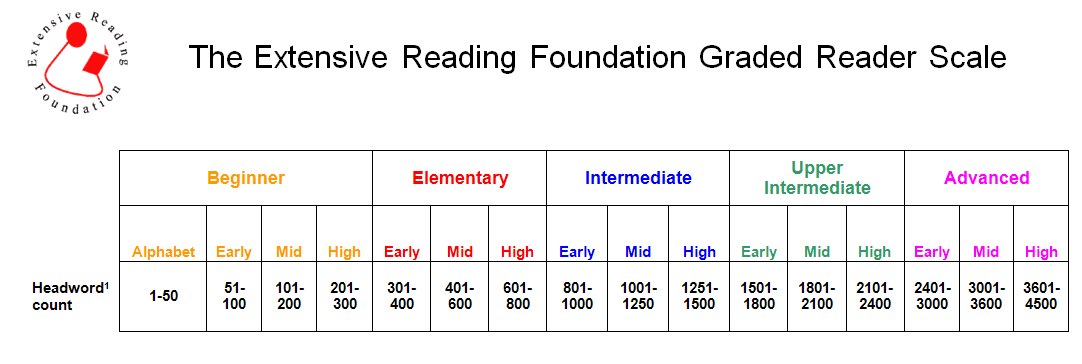
    New Scale for Graded Readers

    The indefatigable Rob Waring has been hard at work with the Extensive Reading Foundation to set up a publisher-independent scale which has recently been published on the foundation's website.


    There is a detailed table that shows how each publisher's own levels relate to this scale with helpful links to every series of graded readers known to mankind.

    In the Humber library, we have always used David Hill's EPER scale, and will continue to do so, but if I were setting up a new program, I'd probably switch to the new scale for its increased breath and detail and since you have to pay for EPER stuff.

    Wednesday, November 25, 2009

    A mere puff

    Do people hear with their skin as well as with their ears? Henry Fountain has an article in the New York Times describing some research suggesting that indeed we do.
    The researchers had subjects listen to spoken syllables while hooked up to a device that would simultaneously blow a tiny puff of air onto the skin of their hand or neck. The syllables included “ba” and “pa,” which produce a brief puff from the mouth when spoken, and “da” and “ta,” which don’t produce puffs. They found that when listeners heard “da” or “ta” while a puff of air was blown onto their skin, they perceived the sound as “ba” or “pa.”
    The problem with this is that syllable initial voiceless consonants, including /p/ and /t/ are aspirated; that is, they produce a brief puff of air, whereas voiced consonants, including /b/ and /d/ are unaspirated. The error appears to be Fountain's; the abstract in the original paper gets it right.

    [The article has since been corrected.]

    Monday, November 23, 2009

    More on imperatives

    Over the weekend, I commented that most of the ten commandments were not in the imperative mood. In particular, I said thou shalt not is in the indicative mood. I've had a number of people query this, so I'd like to explain more.

    Saturday, November 21, 2009

    Ben Yagoda on Language

    Having just written a post questioning the value of taking on a century-old usage book, I turn to a number of columns written by author, critic, and teacher Ben Yagoda, one of which is more than twenty years old.


    Thursday, November 19, 2009

    Jan Freeman's new book


    I may be betraying my lack of education, but I'd never heard of Ambrose Bierce before Jan Freeman offered to send me her book, Ambrose Bierce's Write it Right: The Celebrated Cynic's Language Peeves Deciphered, Appraised, and Annotated for 21st-Century Readers. Or at least I thought I hadn't heard of him. Doing some background reading, I found that I'd actually read some of his short stories in high school or perhaps university. It made me feel somewhat better that only one person in the office here had heard of him at all.

    Saturday, November 14, 2009

    Conrad Black, English teacher

    Conrad Black seems to have discovered the joys of being an English teacher. I'm a little curious, though about his "commending Hemingway's Snows of Kilimanjaro as illustrative of the virtues of short, simple sentences." I assume he doesn't have sentences like the following in mind:

    Friday, November 13, 2009

    Award-winning students

    Most of the students who pass though our English for Academic Purposes (EAP) program end up doing very well in the college. This was highlighted in October when the awards and scholarships were handed out for the school of liberal arts and sciences. Here at Humber, LAS services students in every program and includes some of the most language-dependent courses. Despite this, former EAP students took home many awards:

    Thursday, November 12, 2009

    Subtitles for ELLs

    Holger Mitterer and James M. McQueen have published a paper in PLoS ONE suggesting that if you're a learner of English, you should watch TV with English subtitles turned on. I regularly assign graded readers to students, and I suggest to those who read poorly (i.e., are slow and/or inaccurate at decoding individual words), and those with difficult-to-understand accents that they chose a reader that comes with a CD. I think this is basically the same process. In these learners, there's either no link between phonology and meaning & orthography (spelling), or the phonological representation is faulty. This paper shows that there are benefits to linking them together.

    Monday, November 09, 2009

    100 things restaurant staffers should never do

    One of the most e-mailed stories at the NY Times this week is "100 things restaurant staffers should never do" by Bruce Buschel. This may seem a little glib, but as I was reading it, I was thinking: what a great exercise for language teachers! How many of these can you apply to your teaching situation?

    Saturday, November 07, 2009

    There aren't much data

    When asked by the New York Times why some people get a sore arm at the site of a flu vaccine injection while others do not, Dr. E. Yoko Furuya, assistant director of epidemiology at NewYork-Presbyterian Hospital/Columbia University Medical Center replied, “The short answer is that we don’t know for sure... There aren’t much data out there on this topic.”

    Wednesday, November 04, 2009

    Subordinate clauses

    The Cambridge Grammar of the English Language sets out the language in piercing detail, but I often find it overwhelming and need to step back and bring together what I've read in a way that displays the basic relationships minus overmany particulars. Recently, my attention has been on subordinate clauses. Five years ago I would have said I had a good understanding of subordinate clauses, but how wrong I was. The more I delved into it, the more I found and the more lost I felt.

    In the following taxonomy/tree diagram/organizational chart, or what-have-you, I've attempted to illustrate the relationships between all these various subordinate clauses. As time allows I'll add example sentences to illustrate each.


    PS, If somebody can conjure an elegant way to allow telescoping of the various daughter levels (click-to-expand kind of thing) along with links to example sentences, please let me know.

    Thursday, October 29, 2009

    Aspectual properties of the VP

    Last night I realized that in my previous post about aspectual properties of verbs, I wrote about "stative verbs" and "dynamic verbs". I suppose it is useful to identify verbs that allow stative and/or dynamic interpretations, but I should also have pointed out that in the final analysis, it is not the verb per se that is stative or dynamic. Rather, it is a property of an entire VP. For example, I'm going to have a shower has the dynamic VP have a shower where I have a shower in my basement has the stative VP have a shower in my basement.

    Wednesday, October 28, 2009

    Negating should in questions

    Part III of our dissection of the most recent Grammatically Speaking column brings us to the question: "what's wrong with should not they have permission."

    Richard Firsten opines, "actually, there is nothing ungrammatical with the question Should not they have permission . . . ?, but it's certainly very uncommon and probably never heard or even written anymore. A very long time ago this construction was sometimes used."

    Tuesday, October 27, 2009

    Until he fixes/fixed it

    This post is a continuation of this one. In his usual form, Richard Firsten explains,
    . . . until he fixes it shows that the speaker is dealing with a real situation. We know this because the speaker is using the verb fix in the simple present in the indicative mood. There really is something broken, and from what we can gather, the repairman has asked for payment in advance. What we have here is the advice that the speaker is giving to the person who needs the repair work done.
    . . . until he fixed it shows that the speaker is talking about an unreal situation, a hypothetical case. We know this because the speaker is using fix in the simple present subjunctive mood. Nothing is broken at this time, but the two people are discussing "what-if's," that is, what one or the other would do if such a situation were to develop.

    Monday, October 26, 2009

    Voice not confused with tense by an economist

    Worthwhile Canadian Initiative is an economics blog I read regularly. In his most recent post, Stephen Gordon, an economist accurately diagnoses the shifty use of the passive voice (about two screens down) by a Globe and Mail editorial. It's a small thing, but still encouraging that a non-linguist gets this right at a time when educated people from writers and editors at The Economist to the director of student counselling services at University College Dublin clearly have no idea what the passive voice is.

    Friday, October 23, 2009

    CLB Online Self Evaluation

    A colleague pointed me to the Canadian Language Benchmark's Online self-evaulation site. If you're on a mac, you won't even get past the splash screen, which appears broken, but on windows with Explorer, you should be OK.

    I found no stats about reliability, etc. But it appeared to be a reasonably well-designed test of reading and listening skills. I only tried the English version, but I assume there's also a French version. Off the top of my head, I would say the questions range from CEFRL level A1 to B1, or perhaps B2 with most being in the lower part of that range. There is nothing particularly difficult.

    It appears that the site is still in Beta. Some problems I noticed:

    Thursday, October 22, 2009

    Grammatically speaking is wrong again (and again, and again)

    The newest "Grammatically Speaking" column from TESOL's Essential Teacher magazine is out and, as usual, it's hit and miss with its answers. For past discussions of Richard Firsten's misanalyses, see these posts. As I've said before, I keep coming back to these because it seems to me that it behooves a grammar pundit like Firsten to make sure he's got the right answers. You don't expect perfection, but I think he's only batting slightly above 500. The other reason is that he gets a lot of interesting questions.

    Wednesday, October 21, 2009

    What do people want to know about language?

    The search terms that lead people here are often interesting. Here are some recent gems:
    • plural of t (same as any other letter, I'd think) 
    • how many adverbs are in the sentence: zack jumped incredibly high (this guy thinks Google actually understands his question) 
    • granted as a preposition (it is often) 
    • hair countable (it isn't typically) 
    • is 0 plural or singular (plural when it's like 'zero things are...', but singular in 'one zero is') 
    • what are determinative adjectives in english (I don't know) 
    • three linking verbs (reminds me of a Christmas carol) 
    • free online tests for 10 - 11 year olds (in case you're not sure how old the kids are) 
    • most overused words 2007 (it's still the) 
    • Is the word rather a preposition (I don't think so; I'd say adverb and coordinator)

    Ethical review

    We occasionally get students coming to us with wildly unrealistic expectations about where they will be placed in our program. Some of them think they'll be in the English for Academic Purposes program for two months when in fact they're placed in level 2, which means at least 14 months. Of course, they've already put their lives on hold, invested a bunch of money, and flown over here.

    Sunday, October 11, 2009

    When the parrot sketch disappears ...

    I do understand the importance of data-oriented studies. In fact, I was one of the contributors to the first corpus-based English-Japanese dictionary (the Wisdom EJ from Sanseido).

    When I wrote the entry for 'prejudice', for instance, I included the phrase 'pride and prejudice' because there was a significant number of occurrences of the phrase in the corpus we used, and frankly, this famous title should be known to anyone studying English, whether they have read the novel by Jane Austin or not. Yeah, the story's crap, I know, but it is very well known.

    Wednesday, October 07, 2009

    More computer-graded English

    Today's Toronto Star has an article about a site called Speak2me.cn that uses voice recognition software to help students practice their speaking skills. It's the first free online site I've seen doing this, but it surely won't be the last. In an interesting move, they use product placement in their dialogues as a source of income.

    I wanted to try it out, but you really need to be able to read Chinese to use it. If anybody has more success than me, please, let me know what you think.

    Tuesday, October 06, 2009

    Book Launch tonight

    If you're free in Toronto tonight between 5:00 and 6:00, come to the launch of Slant Room by Michael Eden Reynolds.

    Duo-tang

    All my life, I've been vaguely aware that there's something about the word duo-tang that I was missing. It seemed like such an odd English word. Then, the other day, my daughter brought one home and the meaning hit me: duo = 2, tang = tongue-like projection (you can see three of them in the photo below).


    It seems like I'm not the only one to miss the meaning. Here's a "duo-tang" with not a tang in sight. I suppose, though, that you can forgive the company its expanding use of a brand name.

    Sunday, October 04, 2009

    Had yet to consider this point

    As I wrote my last post, I paused upon writing have yet to. "What's that?" I thought.

    I feels like the present perfect, but instead of the past participle, it has a to-infinitival. Indeed, it seems equivalent in meaning to have not yet + past participle. But if you take out yet, you get have to, suggesting obligation. Are these related?

    Saturday, October 03, 2009

    Scenic Learning

    A recent NewScientist article mentions some research led by Katrin Hille at the Transfer Centre for Neurobiology and Learning.

    "Her team recently tested a novel approach to foreign language classes that originated in a school. Teachers at Gymnasium Kirchheim in Kirchheim by Munich, Germany, had found apparent success with a technique called 'scenic learning', which involves choral recitals of vocabulary accompanied by gestures and movements matched to meaning.
    In a study of 137 students, Hille found those who had used scenic learning remembered three times as many new words 14 weeks later as those who had been taught using conventional methods, and spoke with better pronunciation and fluency. 'I have never seen such strong effects in a previous study,' says Hille."

    The last sentence is pretty startling, but that's the whole thing, and I've been unable to find any mention of it anywhere else. Perhaps it was simply a conference paper that has yet to be published. Anyhow, I've sent off an e-mail, and if I learn anything more, I'll follow up here.