Tuesday, December 26, 2006

Grammatically Speaking III: On pronoun agreement

Still with the Dec. 2005 column by Richard Firsten, (see also, here and here), we come to the issue of the following sentence:
  • If someone feels that they’ve been unfairly passed over for a promotion, they should speak to their supervisor.
My old professor, Patrick Rosenkjar, at Temple University Japan, is credited with providing the first correct response; to wit, "strictly speaking, in formal situations the sentence you cite is grammatically incorrect because the plural pronouns (they and their) do not agree with their singular antecedent (someone)."

I'm afraid not.

As Mark Liberman writes, "singular they has routinely been used throughout the history of English, by all the best writers, until certain subcases were artificially turned into 'errors' by self-appointed experts. Successively less discriminating pseudo-authorities then generalized the proscription in successively sillier ways, although they have largely been ignored by the users of the language."

Similarly, Merriam Webster's online dictionary has this to say. "The use of they, their, them, and themselves as pronouns of indefinite gender and indefinite number is well established in speech and writing, even in literary and formal contexts."

Firsten still isn't buying it. He says that "strictly speaking" it's wrong. I take this to be based on the single-sense fallacy that often turns up in grammatical prescriptivism (see here). That is, a word has a single meaning and other meanings are wrong. In particular, because they means "two or more people or things that have already been mentioned or are already known about", it couldn't possibly also mean "a person or people of indefinite gender and number." This same argument would hold as ungrammatical it to refer to a person since it is "used to refer to a thing, animal, situation, idea etc that has already been mentioned or is already known about." Remember that every time you identify yourself on the phone.

Wednesday, December 20, 2006

Grammatically Speaking; Part II

Continuing on from my last post, in the December 2005 Grammatically Speaking column, Richard Firsten provides a number of questionable answers to language teachers' grammar questions. I'll deal with the first here:
"...During the commercial, the voice-over person says "teeth whitening." Shouldn't it be tooth whitening? I find it hard to believe that whoever writes scripts for commercials would make such a glaring grammatical error, but then again, I'm wondering if they have. What do you say?"
Richard is unequivocal in his response. "You’re right; they're wrong; case closed!"

Well, I asked, is there anything wrong with an antiques show? an admissions committee? A Steelers fan? A singles bar? A publications list? Would you really go for "datum bank", "purple person eater", or "arm race"? What is the plural of manservant?

"No," Richard answered. In fact, he had had a paragraph to account for many exceptions to the rule, probably, he said, due to lower frequency of use than something like toothbrush. Blame the editors.

Well, yes and no. I'm glad to see that Richard accepts exceptions, but frequency has nothing to do with it (and couln't you just argue that teeth whitening is low frequency and be done with it?) No, it's a lot more interesting than that. According to Steven Pinker's Words and Rules.
"A simple explanation, based loosely on Kiparsky (1982), might run as follows. Morphological composition of words takes place in several stages. First there is a lexicon of memorized roots, including, according to the word/rule theory, irregular forms. That lexicon supplies the input to rules of regular derivational morphology, which creates complex words (including compounds)out of simple words and morphemes, outputting a stem. Stems are then inputted to a third component, regular inflection, which modifies the word according to its role in the sentence. In simplified form, the architecture of morphology would look like this:
  1. Memorized Roots (including irregulars) -->
  2. Complex word formation -->
  3. Regular inflection
The word mice, stored as a root in the first component, is available as an input to the compounding process in the second component, where it is joined to infested to yield mice-infested. In contrast, rats is not stored as a memorized root in the first component; it is formed from rat by an inflectional rule in the third component, too late to be inputted to the compounding rule in the second. Hence we get rat-infested but not rats-infested. "
This accounts for the roots with irregular plurals (e.g., purple people eater), but what about the regular plurals (e.g., a red rats eater)? Pinker argues that a phrase can be inserted as the first constituent. That is, you have a [red rats] eater rather than a red [rat] eater. He goes on to argue that the plural in expressions like antiques show, admissions committee, and publications list are one-word phrases, built in the first of the three components above. So, if we have this option, when do we choose to make use of it? When, according to Pinker, we want to emphasise the individuality of the publications, etc. You can read all about it, in the chapter, "of mice and men" in Pinker's book Words and Rules.

In the end, as Margaret Atwood writes, "I felt mice-feet of apprehension," when I read Richard Firsten's prohibition. I hate it when people lay down the law when they've just made it up. Why not allow TV copy writers their "teeth whitening"? Because it's wrong. The wordanistas have spoken.

Heading in the wrong direction

Richard Firsten writes a column called "Grammatically Speaking" in Essential Teacher a quarterly TESOL publication. The premise is that English language teachers write in with their grammar questions and Richard answers them.

Although some of his answers are fine, it's not uncommon that he gets it wrong, sometimes shockingly so.

In his most recent column, the first question is why you can say "how good a student he/she is!" but you can't use the same construction with plurals "*How good students they are!"

Richard answers, basically by saying, 'well it doesn't work with plurals,' (more specifically, it works only with countable singulars) which is fair enough. The actual whys behind many of these questions are opaque even to linguists. But it would be helpful to elucidate, pointing out, as the Cambridge Grammar of the English Language does, that you run into the same issue with so/such.

Not so bad! But then he blows it with the next question: [or not. Update: here]
"In the sentence I'm headed for the beach, what part of speech is 'headed'?"

Richard answers in part,
"Some verbs have given birth, so to speak, to adjectival forms that have distanced themselves from the original meaning of the verbs they come from. For example, when you say She's determined to finish the job on schedule or She's very determined, you’re describing the subject, so you can clearly view determined as an adjective. The use of determined in this context doesn't rely on the verb to determine. Similarly, to head for is obviously a verb, but to be headed for can be viewed as an adjectival phrase in that it will describe a person or thing (If the company doesn't change its fiscal policies, it's headed for bankruptcy)."

In "He is Fred" and "He is running", you're also describing the subject, but that doesn't mean there's anything adjectival about them. The test of an adjective is that it share most of the following properties:
-can be graded
-can be modified by 'very'
-can appear both attributively and predicatively
-can appear in a fused head construction (e.g., the *rich* get richer)

All are true for 'determined'.
they're more determined.
they're very determined.
the determined people / they are determined
the determined are hard to beat

All are false for 'headed'.
*they're more headed
*they're very headed
*the headed people / they are headed (for the lake)
*the headed will arrive sooner

Clearly, 'headed' is a verb.

The second part of the question is, "I think that I'm headed for the beach and I'm heading for the beach mean basically the same thing, which is very strange. I can't think of another sentence where you can use the present participle and the past participle and have the meaning be the same."

Richard brings up rumored for some reason I can't seem to fathom (maybe I'm missing something) but doesn't offer any other verbs that follow this pattern. Anyhow I would say that all of the following are at least as similar as the headed/heading pair:
  • When the Northern hemisphere is pointed/pointing towards the Sun, the days are longer,
  • The hemisphere that is tilted/tilting towards the Sun is warmer because sunlight travels more directly to the Earth’s surface
  • Position the hearing aid so that it is faced/facing towards the. sound chamber speaker.
I think now that classes are finished and I'm headed for the holidays, I'll have some more time to blog so you can look forward to a few more posts on the problems with this column.

Tuesday, December 12, 2006

No Brizendine on Quirks and Quarks

At the end of the Dec 2 edition of Quirks and Quarks on the CBC, Bob McDonald tells us that next week we can look forward to an interview with Dr. Louann Brizendine. Now, Mark Liberman on Language Log has been telling us all about the problems with Brizendine's book, so I thought I'd urge the Q&Q folks to read his posts.

Flash forward to this week's edition and there's nary a word about Brizendine, her book, or her ideas. It would have been nice to have Q&Q expose the problems rather than just sweeping them under the carpet, but at least they didn't just provide her with another vehicle for her baseless claims.

Wednesday, November 29, 2006

Abhor a bore

Responding to my letter to the Orangeville Banner about abhor , Don Hayward writes,

Dear Editor,

The English language is a twisted thing as exposed in Doc Reynolds letter of Sept. 26. (Columnist, and many others, misusing abhor.)

His exploration of abhor was enlightening and humbling, but it strikes me that he missed a few points. For instance, abhor is pronounced somewhat like "a bore" once the H has been scared out of it. There is plenty around Dufferin to scare the H out of things, especially in an election year. As well, abhorred should not be confused with similar sounding phrases such as "I have a bored hole in my head." (This to go along with the normal ones already there, I suppose.).

However, lest the condition of my head makes me abhorrent to you, let me quickly change hats. Abhor is the evil twin to adore, something we are all familiar with. For instance, the one who adored us in first year Humber College abhorred us a year later, or vice versa if you ended up married.

Doug, your next assignment is to use the word synergy. That should draw Brett out again. Keep it up guys, my television is broken and these are words worth knowing.

Don Hayward,

Shelburne

It's also a bit like adhere, with a backwards b. Kinda makes you feel unglued.

Friday, November 24, 2006

Quite worthy

My aunt, who I greatly respect and whose company I very much enjoy, and I were hashing out the consequences of Geoff Pullum's latest Language Log post the other night, when somehow we got around to the question of quite.

"Unneeded", my aunt said. "At least in writing. Back when I was editing, I would remove it whenever I encountered it. People asked what we'd put in to replace it, and I would ask them what they put in to replace the cobwebs when they swept them from their corners." (I'm going from memory here.)

I had to disagree.

Brian Garner, in Garner's Modern American Usage elucidates the differences in meaning between British and American uses, but declines to opine on quite's utility despite having no such qualms about other words, such as very, which he describes as
"a weasel word. This intensifier, which functions as both an adjective and an adverb, surfaces repeatedly in flabby writing. In almost every context in which it appears, its omission would result in at most a negligible loss."
I'm not sure whether Garner actually sees a difference between quite and very, simply hasn't noticed quite, or had reached his word limit for his book. At any rate, to my mind, there is quite a role for quite. As the 405th most common word form in written academic English, clearly it's got something behind it. But maybe that's only the mediocre writers. How about the greats?

Well, Bram Stoker's Dracula has just shy of 100 instances of quite including,
"I begin to get new lights on certain things which have puzzled me. Up to now I never quite knew what Shakespeare meant when he made Hamlet say, "My tablets! Quick, my tablets! 'tis meet that I put it down," etc., For now, feeling as though my own brain were unhinged or as if the shock had come which must end in its undoing, I turn to my diary for repose. The habit of entering accurately must help to soothe me."
Speaking of Shakespeare, the bard thought quite worthy enough to redouble in Hamlet.
O, what a noble mind is here o’erthrown!
The courtier’s, scholar’s, soldier’s, eye, tongue, sword,
The expectancy and rose of the fair state,
The glass of fashion and the mould of form,
The observ’d of all observers,–quite, quite down!
And it is not limited to fiction, Charles Darwin, in laying out the foundations of modern biology, wrote,
"In considering the Origin of Species, it is quite conceivable that a naturalist, reflecting on the mutual affinities of organic beings, on their embryological relations, their geographical distribution, geological succession, and other such facts, might come to the conclusion that each species had not been independently created, but had descended, like varieties, from other species. Nevertheless, such a conclusion, even if well founded, would be unsatisfactory, until it could be shown how the innumerable species inhabiting this world have been modified, so as to acquire that perfection of structure and coadaptation which most justly excites our admiration."
And of course, going through old e-mails from my aunt, I found numerous instances of quite.

So, should it stay or should it go? In my readings, I have certainly found places where quite adds little, but often it conveys something that is lacking without it: degree.

But, if I am wrong, and quite and very are to be ditched, should we not also get rid of all degree qualifiers--altogether, absolutely, completely, entirely, fully, perfectly, thoroughly, totally, utterly and wholly dispose of them? Regardless of how badly we may wish to use them? How bitterly disappointed we might be to see them go? How deeply we would miss them? Or is there a distinction I'm missing? Perhaps this was why Garner just focussed his attack on 'very'; it was bid to weasel his way off the slippery slope.

Many vs. a lot

Over on the ETJ list, Nick M. says that his student was marked wrong for answering "Yes, I have many teachers," to the question, "Do you have many teachers?" Nick wonders if there's some grammar rule that he's missing.

No, grammatically, "I have many teachers" is fine.

Stylistically, however, it is rather stilted, with 'a lot of' being preferred.

Pragmatically, it is both redundant in it's repetition of "(I) have many teachers" and uncooperative in it's failure to provide a shred more information than the surface form of the question requires. A more pragmatically appropriate answer would be something like, "Eight, if you can believe it."

Arnold Zwicky undertakes a quick survey of 'much' vs. 'a lot' over on Language Log. I think the issues around 'many' are quite similar; indeed, Zwicky touches on them in his explorations.

Can you say, "a lot of bunk?"

Over on the ETJ list, a member writes, in part,
I was brought up in a midwest family where "a lot" meant a piece of ground, and not "many". Different generation grammar usage?...

We also learned that "Can I go to the store?" brought the answer "Yes, you can, ...but you may not."
No doubt, the parents thought they were "protecting" the language (or perhaps the children). There is, however, absolutely no grounds for this except the false idea that words have only a single sense. Clearly they don't. The Longman Dictionary of Contemporary English gives 31 senses of work and that's just the verb. Lot similarly, if less spectacularly, has a number of common senses; I wonder what the father would have called a parcel of articles offered as one item in an auction? Can, too, has multiple uses, including ability, requests, possibility, and permission.

Merriam Webster's has this to say:
"Can and may are most frequently interchangeable in senses denoting possibility; because the possibility of one's doing something may depend on another's acquiescence, they have also become interchangeable in the sense denoting permission. The use of can to ask or grant permission has been common since the 19th century and is well established, although some commentators feel may is more appropriate in formal contexts. May is relatively rare in negative constructions (mayn't is not common); cannot and can't are usual in such contexts."
So, is it a generational thing? Only in the sense that younger people rarely think to inflict their linguistic preferences on others. But if the question is whether this has changed, indeed, it has, just not within the lifetime of the father. Lot in the sense of a large number goes back to at least 1812 which is not all that long after it was first attested in the meaning that the father prefers.

Tuesday, November 14, 2006

Refuting anti-translationist propaganda

Over on the TESL-L mailing list, Mert Bland, Dean of Graduate Studies at CBU (That's Central Buganda University, not Christian Brothers University), is making his same tired claims about vocabulary teaching. One of my responses, which garnered a lot of positive response, is reprised here:

The folks who buy into the anti-memorisationist agenda tend to be the same who hold anti-translationist ideologies. Yet the arguments they marshal in their attempts to rationalise these extreme positions do not bear scrutiny and, to the extent that they are true, can usually be applied equally to learning vocabulary without the L1.

Take, for example, the recent claims by Mert:
"no concept in the the target language is a direct translation of a concept in the native language."

First of all, this is simply false. Admittedly, some words will not overlap well. However, to the extent that any two native speakers of a given language share a common understanding, the meaning of the vast majority of nouns, verbs, and adjectives will be the same in translation. For example, 'book' will have a one-to-one translation in almost every major natural language.

Anti-translationists will say "gotcha! What about book used as a verb, as in 'book him for murder'?"

The *noun* 'book' will have a one-to-one translation.

"Ha!" say the anti-translationists. "My concept of book includes electronic books, while that of pre-industrial hunter-gatherers in the Amazon rainforest does not." To which we calmly reply, "nor does that of my grandfather, though he is a native speaker of English."

Not only is the argument false, but even if one were to imagine it to be true, it is only relevant if we take the position that it is best to fully and accurately specify the meaning of a word when teaching/learning it. Yet, clearly, here, translation does a better job--not the straw-man single-word translation example being bandied about here in the form of English 'leg' to Japanese 'ashi', but the use of the L1 to translate AND explain the word. English synonyms and paraphrases will typically be only as good as, and likely worse than the L1, and are almost sure to be less comprehensible to many learners.

Mert goes on to argue:
We try to bifurcate the languages, completly separate retes. This can't be done if individual vocabulary items are tied together in the two concept clusters.

This takes a very naive view of the brain and attempts to make arguments based on ideas that even neurolinguistic experts are unclear about. It also conveniently ignores the fact that after the teacher spends 10 minutes gesticulating, explaining in English, and searching for props, the students will finally go, "Aha! He means (L1 word)." This activation of the L1 translation is almost certainly automatic and unavoidable in most cases, yet it is just what this teacher was trying to avoid.

Mert also makes the point that "A connection once made is hard to break; these things tend to fossilize."

If this is true, then it is a good reason to make sure the connection is the correct one by using the L1 and not a mistaken guess about what a given pantomime means. If it is false, then there is no reason to think that the gradual changes and refinements of a meaning that accrete with exposure to the word in multiple contexts will be any more difficult if one starts with an L1 connection than if one could somehow begin with a pure, non-linguistic concept.

(Please note that I'm not arguing that teachers should be experts in the L1s of all of their learners, just that they should allow the L1 its place when possible.)

Tuesday, October 17, 2006

Real gone difference

I was somewhat taken aback recently when a disucssion on the ETJ mailing list brought to light the different interpretations of the 's in "Where's my car? It's gone." It turns out that most North American speakers of English interpret this as "My car is gone?" while British speakers tend to parse it as "My car has gone."

In the NA interpretation (and my own), gone is an adjective meaning "to be no longer in a particular place". Furthermore, in NA English, the present perfect construction favoured by the Brits is interpreted to mean that the car itself left, but that's discounted as the car can't leave of its own accord. Strictly speaking, this use of go is not limited to animate agents; yet the agent must at least appear to move on its own. Consider:
  • The mist is gone. (The mist seems to move of its own volition; the wind and sun are unseen.)
  • The pain is gone. (We view pain as an entity which comes and goes.)
  • The bus is gone. (The bus driver is an integral part of the bus and can be expected to be inside.)
The British interpretation takes the verb go to mean disappear, which is indeed the sense that the NAs have of the adjective, but don't accept for the verb.

I wonder how many other contractions are masking interpretations that have gone their separate ways.

Monday, October 16, 2006

No Ojibwe owns a skunk

The linguist Bill Bright, has passed away. While I was reading through some of his talks, I came across the following story about Edward Sapir.
"Examples presented in the grammar should be based as much as possible on naturally occurring utterances, not on strings of morphemes or words which the linguist creates himself, or obtains by direct elicitation from speakers. To whatever extent examples fail to represent natural utterances, they fail to represent the cultural context of the language. Sapir is said to have asked an Ojibwe to say “my skunk, your skunk” etc., in order to test a morphophonemic hypothesis; but the Indian rightly refused , saying “No Ojibwe owns a skunk.” The fact that no Ojibwe owns a skunk is a cultural fact which should not be falsified."

Wednesday, October 11, 2006

Search terms

I will admit to regularly and vainly checking my blog hit count. Part of the report tells me how you got here. Many users find their way over from Language Log, but it's amazing to me how many of you arrive because you've searched for wake woke woken waked awakened or some combination of the above (which I discussed here). In fact, of the past 25 viewers, fully 1/5 of you came because something has awoken in you a curiosity about these verbs. And this has been going on consistently since mid September when I brought it up.

Who knew woke was such a burning issue?

Monday, October 09, 2006

Asking why

The Toronto Star has been running a series of promotions with the tag line, "ask why". Unfortunately, their misuse of numbers might lead many to ask why they are promoting their inability to explain research results and numbers.

On Saturday, they wrote that "A comparison of seven Ontario municipalities has shown that Torontonians are by far the most diligent recyclers in the province." This could only be true if it had already been established that those seven were the top seven in the province.

Today, the "ask why" promo makes the suspiciously exact yet meaningless assertion that "242 new immigrants call Toronto home." No time period is mentioned.

[They now have corrected the second ad to read "242 new immigrants call Toronto home every day." (my emphasis)]

Wednesday, October 04, 2006

They live in what?

One of my students submitted a rough draft recently with the sentence, "While coffee makers take large profits, coffee farmers must live in extreme puberty."

Probably the Cupertino effect.

(Please, note, my intention here is not to disparage my students, who are writing in a foreign language.)

Monday, October 02, 2006

Popular graded readers

And speaking of extensive reading, our department has recently been given a bit of money to expand our catalogue of graded readers, so I asked the library to get me the circulation data on our existing books. Although we have a variety of titles, the top 20 were almost all from the Oxford Bookworms series, and most of them were classics. Here are the top 10 (from most popular to least)
Oliver Twist Dickens, Charles
Sense and sensibility Austen, Jane
Tess of the D'ubervilles Hardy, Thomas
Far from the Madding crowd Hardy, Thomas
Great expectations Dickens, Charles
Wuthering heights Bronte, Emily
Ring, The Smith, Bernard
David Copperfield Dickens, Charles
Little women Alcott, Louisa
Three men in a boat Jerome, Jerome
Of these, only The Ring is not from OUP (it's a Penguin title). The other two in the top 20 that are not OUP are The Client, also Penguin, and Help! from Cambridge.

Anybody care to share their students (or their own) favorites?

Extensive Reading for the budget conscious country

On the Extensive Reading mailing list, Dave Kees floated the idea today that China (or likely any developing country) could use extensive reading exclusively. (Extensive reading (ER) involves reading tens of thousands of words per week in the target language. This is made possible by keeping the difficulty of the material largely within the comprehension level of the reader, usually by controlling the vocabulary of the text.)

Dave suggests that, even if ER weren't quite as effective as using a variety of teaching methods,
"China should think about what the impact would be and the cost savings be (sic) if they gave Comprehensible Input a wholehearted tryout, especially considering the difficulty of many high-maintenance foreign teachers and the trouble, heat and friction of the age-old academic battles between grammar-translationalists and communicative approachers."
If I had all the freedom in the world to set up my ideal program, I don't think I'd go for 100% ER, or even 100% ER with accompanying audio, as Dave is suggesting. Still, if you look at the cost/benefit ratio of French classes in English-speaking Canada or of English classes in Japan, it would be hard to do worse.

Thursday, September 28, 2006

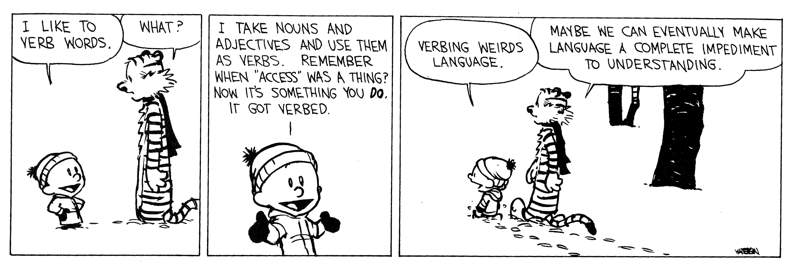
Early verbing

In browsing through the journals of the Royal Society, dating from 1665 and now available to all and sundry for FREE online, I came across an article entitled, "An Accompt of D. Paulus Biornonius, Residing in Iceland, Given to Some Philosophical Inquiries Concerning That Country, Formerly Recommended to Him from Hence: The Narrative being in Latine, 'tis Thus English'd by the Publisher"

So there you have it, English as a verb, and from 1674, nonetheless.

And the classic Calvin and Hobbes strip is here.

Monday, September 25, 2006

Synesis synchronicity

In a happy coincidence, I randomly opened Garner's usage (which I borrowed from the library to follow up on the existential question of woken up) and found myself looking at the entry for handful (which came up in discussing "treeful of starling"). Garner explains why a handful of (plural noun) commonly takes plural verb agreement even though the subject, handful, is singular, and refers the reader to synesis.

This was a new word for me, but it was a concept that came up back in August, when we looked at there's vs. there are.

So there you go, three posts linked with one word.

Saturday, September 23, 2006

New grammar column in the Globe and Mail

Last Thursday, novelist, fashion writer, and host of CBC Radio's summer language show, "And Sometimes Y", Russell Smith began a new column in the Globe and Mail called On Grammar. In the first week, he takes a pragmatic view on comma usage.
"Fewer commas are being used in contemporary writing. (In technical terms, there has long been a schism between "open punctuation," which uses punctuation only as necessary to prevent misinterpretation, and the more traditional "closed punctuation," which is meticulous in matching every grammatical situation with its appropriate markings. Most magazines use open punctuation now.) This, again, is just a question of modern tastes -- once again, it comes down to aesthetics."
(Thanks to Joe Aversa for pointing this out to me.)

[added Jan 12, 2007: The column has turned out to be rather poor. See here.]

Friday, September 22, 2006

Waked up again

In my gobsmacked amazement at the inaccuracy of the claim that "there is no woken up", it seems that I have misconstrued June Casagrande's intention. She wrote to tell me that the article was not in earnest and that her own feeling about the past participle of wake up is the same as mine. The fault, it seems, lies with Garner's Modern American Usage. Garner writes,
"The following are the preferred declensions:
wake > woke > waked (or woken)
awake > awoke > awaked (or awoken)
awaken > awakened > awakened
wake up > woke up > waked up
...For the past participle, AmE prefers waked; BrE prefers woken."
In his list of irregular verbs, however, he has the order reversed with "wake woke woken (or waked)".

So there it is: it's Garner who gets it wrong, athough not nearly as emphatically as all that.

June also pointed out that I was lax in my own homework. She hasn't started writing a column; the column is established. It is the book that is new. Mea culpa.